The Definitive 1950s Science Fiction Reading Challenge

By James Wallace Harris, Tuesday, January 13, 2015

Over at Worlds Without End, they routinely offer reading challenges for people who use their science fiction book database. My post “The Defining Science Fiction Books of the 1950s” inspired their page, “The Defining Science Fiction Books of the 1950s” which displays the books from the list in their database format, nicely illustrated by book covers. You can join and tag books you own, want to read, have read, or want to buy and read. You’ll need to sign up and set a password, but that’s no big deal.

World Without End has collected many award list and best-of book lists, so it’s a great way to find outstanding science fiction books to read.

If you click on “Roll-Your-Own” image, you’ll be taken to a list of Reading Challenges.

2015 Reading Challenge

Then look for this icon.

1950s challenge

After you sign up, you can always go directly here, where you can see a list of members in the challenge, and which books they are reading or have read. The challenge is to read one book from each year 1950-1959 from the Defining List of 1950s SF. Look through the years to select each book you want. Clicking on the cover will allow you to mark the book read, reading or unread, and you can check to use it for the challenge.

The books go in the list 10, 9, 8, 7, 6, 5, 4, 3, 2, 1. So if you want the books to read 1950-1959, left to right, you’ll need to enter all 10 starting with the 1959 first, and go reverse order years. Otherwise, if you add them one year at a time, the final list will read 1959-1950. Since I don’t want to commit what book I’ll read for each year until I read them, I’m entering in reverse order.

This is a fun reading challenge for those people who love classic science fiction. The 1950s were when science fiction book publication ramped up, and many of the classic stories from the 1920s, 1930s and 1940s were reprinted in hardcover and paperback. I started 1950 by rereading The Martian Chronicles, which were short stories Bradbury wrote in the late 1940s, but collected together to create a fix-up novel of related tales. I listened to an audiobook edition read by Stephen Hoye, and it was excellent. The characters sound like I’m listening to a 1940s movie.

There is also a forum at the WWE site for discussing the books in the challenge.

If you love old SF, and want to see what other people are reading and saying about these old books, give it a try.  After the 1950s are finished, DrNefario, the creator of the challenge, plans to create one for the 1960s.

JWH

Why Does the World Suck?

By James Wallace Harris, Tuesday, January 13, 2015

We’d all be happier people if we didn’t watch the news on TV. Most people I know are depressed by events around them, some happening close by, some far away. But if you think about it, the world sucks for very few essential reasons, most of which deal the threat of harm to our bodies. We fear war, terrorism, crime, violence, natural disasters and disease. And those break down into two causes, threats from people and threats from nature. And if we solved the problem of violent people, I think most of our reasons for being depressed about our life on Earth would disappear. We can see the world as sane even if it has cancer and tornadoes, but all the human generated violence makes us think we live in an insane reality. In other words, injustice comes from other people, and not nature.

Avoiding depression when watching the local news is very hard. The stories of murder, rape, home invasions, shootings, gang crime, brawls, berserk shooters, road rage, muggings, robberies, holdups, makes us anxious to exist. Listening to international news about all the variations in wars and terrorism makes us think humans are incapable of reason and sanity.

If all violence stopped, can you imagine what a psychological uplift it would give humanity. We’d be free to work on all the other problems we face. Yet, our solution to violence is more violence. That’s why seeing a film like Selma is so inspirational. That’s why having a holiday for Martin Luther King, Jr. is so important.

As Eldridge Cleaver said, “If you aren’t part of the solution, you’re part of the problem.” I think that’s very insightful, but all too often many people become part of the problem by pushing their solution, which all too often if fight violence with violence. Cleaver fell into that trap. This is different from self-defense, but most people can’t see the dividing line. We need some way to neutralize violent people without going to war or arming ourselves like a special forces soldier. For the last couple centuries this has been the police. If you look around the world and study places without police, you’ll find no civilization. If you find places where the police are corrupt, you see civilization crumbling.

Yet, the police can’t prevent all problems of violence. A strong police force can deter, but we need more teachers, psychologists and social workers to identify and help troubled people. We need more parents and mentors to observe and guide young people. We need more leaders, artists and visionaries to inspire nonviolence.

The trouble is too many young men see violence as the solution, whether they are ISIS, Al-Qaeda, Boko Haram, urban gangs, organized criminals, drug cartels, Hamas, FARC, Taliban, or lone wolf madmen, and we need to study why they join these groups, to solve the problem. Just killing them only seems to inspire more of them to come into existence.

In some ways, we can say the world sucks because there’s too much testosterone. And if you combine testosterone with guns, you get all the groups I mention above. Just killing crazed gunmen isn’t enough. We need to understand why people become crazed gunmen.

JWH 

My Never Ending War On Procrastination

By James Wallace Harris, Tuesday, January 6, 2015

The first book I read for 2015 was Solving the Procrastination Puzzle by Timothy A. Pychyl. The short book had a few good insights, but the introductions annoyed the crap out of me. It seemed like the author was procrastinating from getting down to the point of the book.  The link above takes you to Pychyl’s website where he had a bunch of resources to help fight procrastination.

zen7

I’ve been procrastinating my whole life. Why do today what you can put off until tomorrow is my motto. However, tomorrow has arrived today, with a huge to-do list.  Let’s hope 2015 is the year I get things done. One technique I’ve discovered after trying all sorts of software and web based to-do lists is to wake up and think of five things to do today. I don’t use any software or Moleskin products, but just right them down on a scrap of paper.

Since I’m going easy on myself starting out, I’m picking five relatively simple things to do. Things like “- put up Christmas decorations” or “- reply to Linda’s email.” I threw myself a curve this morning “- clean out my email inbox.” I’ve been procrastinating on that one for a week.  A week ago I had zeroed out my inbox, now its back to 293. Email is insidious.

One way I shirk my tasks if by writing a blog like this one. Damn, I should have written “- write blog about getting organized.”  I don’t allow writing down tasks if I do them before I write them down – doesn’t seem sporting. Mornings, when I wake up, but I’m still too lazy to get up, are the best time for thinking of tasks without doing them. If I go to bed having done the tasks I thought up that morning makes the day feel productive, even if they were tiny jobs.

Another gimmick I’ve found for organizing my shit is to just do a task when I think of it. This helps since I often forget it before I can find my piece of paper. This only works if the task is pretty small – like folding clothes out of the dryer or cleaning the sink with comet when I see it needs it.  Those kind of tasks only take a few minutes. I’ll never stop and quickly write a novel to get it out of the way, but doing impulse tasks are quite satisfying. Last May I wrote “Does An Organized Desk Mean and Organized Mind?” I’m slowly making those ten tips into habits. I’m quite proud that I always do the dishes immediately after eating, even when I have company. And I’m slowly improving on decluttering. But I’m still far away from being organized and disciplined, at least by my dreams of getting bigger tasks accomplished.

In some ways, my eating self-control relates to my getting tasks done self-control. I strictly followed my no junk food diet last summer until the night of Halloween, when I couldn’t resist Trick or Treating myself. One Reese’s cup on October 31st, and I went on a chocolate bender that lasted until December 31st. Now that I’ve abandoned the chocolate and ice cream again, I seem to be focusing more on getting things done.

Since I’m retired, I imagine some of my friends wonder why I just don’t let myself go, do whatever I feel like, and have fun all the time. I’ve tried that – often, and it is a lot of fun. But it seems learning to be disciplined helps with having unlimited free time. I seem to have more time when I’m active. I know that sounds bizarre, but it’s very easy to sit down after breakfast, start listening to music and quickly discover it’s four-thirty in the afternoon. Being retired has taught me why the British dressed for dinner in the jungle.

By the way, I got a nice Christmas present from Worlds Without End.  They put my defining SF books by decades series in their database. Thanks to Dave Post and all the editors over there. If you’re looking for ideas for science fiction books to read, check out Worlds Without End.

JWH

Physical Bookshelves versus Kindle Library

By James Wallace Harris, Monday, January 5, 2015

I’m in a buying quandary. Is it better to own a hardback or a digital book? This particular problem arose just now because I’m wondering how to acquire Ada’s Algorithm by James Essinger, a new book about Ada Lovelace. At Amazon it’s $12.99 for the Kindle edition, and $19.41 for the hardback. I’d save $6.42 by buying the digital book – that’s a good bit for a retired person. But since I routinely buy used hardback books for $3-5, I’d could save even more if I wait. But then Mr. Essinger would earn no royalty.  In fact, while reading about Ada’s Algorithm I see that he also wrote Jacquard’s Web, which I immediately bought just now for $4 (1 cent for the book, $3.99 for shipping). If I waited I could eventually get the same deal on the book about Ada Lovelace.

However, there is more to my buying decision than price. In the long run – defined as rest of my life – is it better to own a hardback or ebook? Which format is easier to read? Which format is easier to review? Which format is easier to reference and look stuff up?  Which format is easier to lend to friends? Once I start thinking about all these other factors, my brain begins begging for a nap.

ada_800x494

I love holding a hardback book. I love their dust jackets. But I don’t like owning a lot of possessions. I often cull my old books and give them to the Friends of the Library after I’ve read them, so buying the hardback doesn’t mean owning it for life. One advantage of buying the Kindle edition at Amazon is I own it without having to shelve and store it. In other words, Kindle books don’t weigh heavy on my sense of possessions, and thus I have them as long as Amazon remains in business, which if I’m lucky, is for the rest of my life.

If Kindle books were as exactly usable as hardbacks I think I would always buy the Kindle edition. Unfortunately, they aren’t – at least not at this moment. Hardbacks are far more user friendly when it comes to flipping around the book, and reading randomly. Hardbacks are nicer to lend to friends, and use for reference. Kindle books are easier to hold. Kindle books are easier to copy quotes from. And I can find a Kindle book faster.  And it’s a snap to search for a keyword.

I really wish Amazon would put some major effort into making managing my digital library more fun and useful. I own a whole lot of Kindle books I’ve forgotten that I own. Kindle books would be more appealing for collecting if we had better library management tools.

Man, my brain is really begging for a nap now. If Ada’s Algorithm had been $7.99 for the Kindle, I would have bought it immediately, and not even thought about writing this essay. Mr. Essiinger would have gotten paid, and I would be reading. Instead, I’ll wait for Jacquard’s Web to show up in the mail. In other words, price will determine what kind of book I buy. Next Christmas when I’m going through my old Wish List items at Amazon, I’ll see Ada’s Algorithm and if there’s a cheap hardback, order it. I ordered four or five books that way this Christmas when I was reviewing my Wish List for things to tell my wife what I want Santa Claus to bring me.  Hell, I don’t mind when Santa has to pay new hardback prices. I wish I had gotten Santa to get me the Ada book this Christmas.

That said, I do wish I had digital copies of all the books I’ve ever read or owned. I often give away books and later want to look at them again. Publishers want to raise ebook prices. That’s their prerogative.  As long as I can get used hardbacks for $3-5, then that’s the price that makes my decision. I’d be willing to pay two or three dollars more for ebooks, so the author gets paid, but not two or three times as much.

Finally, if I wait long enough, I see the ebook edition of books I want in the Kindle Daily Deal or Bookbub for $1.99. At that price I often buy books I’ve read just to have a copy for my digital library. Someday I don’t think I’ll have bookshelves or own hardback books, and it might even happen before I die. (Yes, it’s always about me.)

JWH

2014 Year in Reading

By James Wallace Harris, Thursday, January 1, 2015

Since 1983 I’ve kept a log of books read, noting the title, author and the date I finished the book. Over the years this has proved very rewarding and useful. This year I switched from using an old notebook to using the spreadsheet in Google docs because it allows me to search and order my list in different ways.  The spreadsheet also allowed me to add some new columns of information to collect – year published, type, and the format of the book I read. I wish I had started this log with the first book I ever read on my own back in grade school, whatever that was. I think it was a Scholastic abridgement of Up Periscope by Robb White. In the early 1970s I kept a similar log for 18 months, when I dropped out of college and read 479 books. I wish I had that list now. The older I get the more I wish I had systematically documented my life.

This year I read 67 books, up from 52 in 2013, 49 in 2012, 58 in 2011, which was my last big reading year. I thought I might read over 100 books this year since 2014 was my first full year of retirement. I know many bookworms that do read 100, 200 and even more books a year. I don’t think I’ll ever be that kind of bookworm. I’m guessing between 50-75 books is the most I can digest in one year.

I believe this year I read more nonfiction books than in past years, with 29 out of the 67, and more new books, 26 of the 67 were published in 2013 and 2014, which was my reading goal from 2013. My complete list of books read in 2014 is at the bottom of the essay. In the past I’ve listed my top five favorites, but this year I read so many great books I’m listening my top ten.

Favorite Novels Read in 2014

  1. Breakfast at Tiffany’s by Truman Capote
  2. Stoner by John Williams
  3. House Rules by Jodi Picoult
  4. Possession by A. S. Byatt
  5. Timescape by Gregory Benford
  6. Life After Life by Kate Atkinson
  7. The Goldfinch by Donna Tartt
  8. Summertime by J. M. Coetzee
  9. Everything I Never Told You by Celeste Ng
  10. The Bell Jar by Sylvia Plath

Favorite Nonfiction Books Read in 2014

  1. Capital in the Twenty-First Century by Thomas Piketty
  2. The Trouble with Physics by Lee Smolin
  3. Time Reborn by Lee Smolin
  4. The Beginning of Infinity by David Deutsch
  5. The Innovators by Walter Isaacson
  6. The Bully Pulpit by Doris Kearns Goodwin
  7. Short Night of the Shadow Catcher by Timothy Egan
  8. How Jesus Became God by Bart D. Ehrman
  9. Hellhound on his Trail by Hampton Sides
  10. Factory Man by Beth Macy

That doesn’t mean the other 47 books were bad, but these were the standouts. Every year I try to read one large 19th century classic. This year I read The Portrait of a Lady by Henry James. It was very good, but not great.  I also like to read old forgotten science fiction novels, and the two I picked this year, Goslings by J. D. Beresford and Herland by Charlotte Perkins Gilman both dealt with imagining societies of women without men. Both were engaging reads, but on the esoteric side. I only recommend them to historians of feminism and science fiction. But both were big fun to me.

I also like rereading science fiction novels I first discovered as a teen to see how they hold up. Two of my favorites from the 1960s were Nova by Samuel R. Delany and Dimension of Miracles by Robert Sheckley. Both from 1968. I still like them, and even admire them, but the tides of time are eroding their once beautiful beaches.

As an experiment, I read one book, Timescape by Gregory Benford, and then a week later listened to it, which I wrote about in “Printed Book v. Audio Book.” The experience only validated what I’ve known for years, and that is I get far more out of fiction when I listen than when I read with my eyes.

Novel and Nonfiction of the Year

Breakfast-at-TiffanysCapital_in_the_Twenty-First_Century

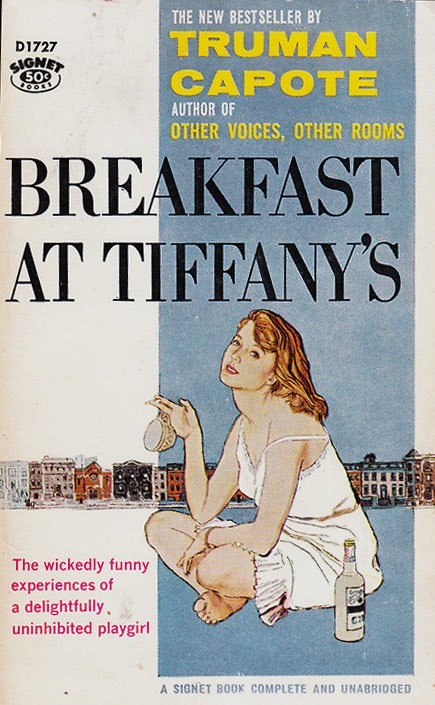
I wish the Capote novel wasn’t always overshadowed by the Audrey Hepburn film. I love the movie, but the novella is on much higher plane of existence than the movie.  I didn’t discover that until this year. When I image searched on “Breakfast at Tiffany’s” all the pictures were from the movie. Even when I added “paperback” – Audrey’s beautiful face dominates. Listening to the Michael C. Hall narration of Capote’s story brought the story to life far differently from my own reading year’s ago. I’m such a poor reader of fiction that I should always leave the job to experts. I did find this old Signet paperback cover that helps forget Audrey’s, but it’s still not a cover the book deserves.

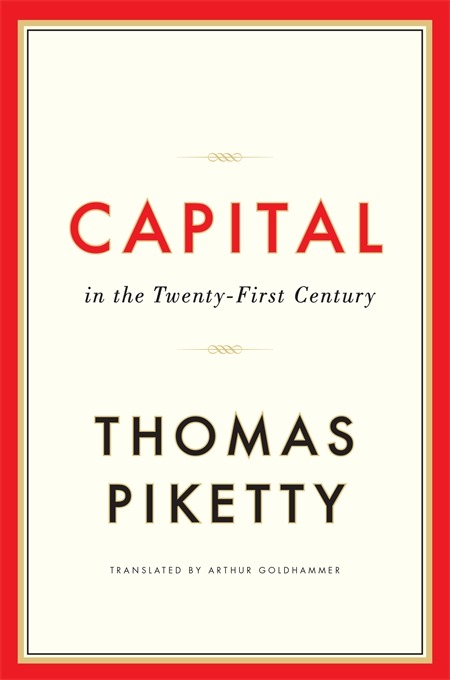
The reason why I picked Capital in the Twenty-First Century is because it’s a magnificent work of history, literary commentary and economic insight. It’s also a very significant book everyone should read.

Reading Log for 2014

Title Author Pub. Finished F/NF Format
The Beginning of Infinity David Deutsch 2011 Jan 11 NF Audio
The Master Colm Tobin 2004 Jan 16 F Audio
The Portrait of a Lady Henry James 1881 Feb 01 F Audio
Difficult Men Brett Martin 2013 Feb 06 NF Audio
The Goldfinch Donna Tartt 2013 Feb 06 F Kindle
Citizen of the Galaxy Robert A. Heinlein 1957 Feb 10 F Audio
David and Goliath Malcolm Gladwell 2013 Feb 13 NF Library HB
Dawn Octavia Butler 1987 Feb 13 F Audio
The Trouble With Physics Lee Smolin 2006 Feb 21 NF Audio
The Bully Pulpit Doris Kearns Goodwin 2013 Mar 08 NF Audio
Keep the Aspidistra Flying George Orwell 1936 Mar 09 F Audio
House Rules Jodi Picoult 2010 Mar 20 F Audio
Short Night of the Shadow Catcher Timothy Egan 2012 Mar 28 NF Library HB
Time Reborn Lee Smolin 2013 Mar 28 NF Audio
The Major of MacDougal Street Dave Van Ronk 2006 Apr 01 NF Audio
Ava Gardner: The Secret Conversation Peter Evans 2013 Apr 06 NF Library HB
Die Empty Todd Henry 2013 Apr 08 NF Audio
Brittle Innings Michael Bishop 1994 Apr 10 F Hardback
In the Heart of the Sea Nathaniel Philbrick 2000 Apr 18 NF Audio
Accelerando Charles Stross 2005 Apr 29 F Audio
The Robots of Dawn Isaac Asimov 1983 May 06 F Audio
Goslings J. D. Beresford 1913 May 10 F Audio
All Flesh is Grass Clifford Simak 1965 May 11 F Paperback
Odds Against Tomorrow Nathaniel Rich 2013 May 17 F Audio
On Looking Alexandra Horowitz 2013 Jun 03 NF Audio
The Martian Andy Weir 2014 Jun 09 F Library HB
Possession A. S. Byatt 1990 Jun 11 F Audio
Robert A. Heinlein – volume 2 William H. Patterson 2014 Jun 23 NF Hardback
Survivors Terry Nation 1976 Jun 28 F Trade PB
How Jesus Became God Bart D. Ehrman 2014 Jul 07 NF Library HB
Capital in the Twenty-First Century Thomas Piketty 2014 Jul 17 NF Audio
Did Jesus Exist? Bart D. Ehrman 2012 Jul 19 NF Library HB
The Bell Jar Sylvia Plath 1963 Aug 03 F Trade PB
Herland Charlotte Perkins Gilman 1915 Aug 08 F Audio
Factory Man Beth Macy 2014 Aug 20 NF Audio
The Postman David Brin 1985 Aug 21 F Library HB
Wide Sargasso Sea Jean Rhys 1966 Aug 25 F Trade PB
Ancillary Justice Ann Leckie 2013 Aug 26 F Audio
Breakfast at Tiffany’s Truman Capote 1958 Aug 27 F Audio
The Second Machine Age Brynjolfsson & McAfee 2014 Sep 04 NF Audio
Lock In John Scalzi 2014 Sep 08 F Audio
Dimension of Miracles Robert Sheckley 1968 Sep 10 F Audio
The Everything Store: Jeff Bazos Brad Stone 2013 Sep 13 NF Library HB
Stoner John Williams 1965 Sep 15 F Audio
The Perks of Being a Wallflower Stephen Chbosky 1999 Sep 18 F Audio
The Death of Ivan Ilyich Leo Tolstoy 1886 Sep 19 F Audio
Home is the Sailor Robin Lee Graham 1983 Sep 25 NF Library HB
A Separate Peace John Knowles 1959 Oct 03 F Trade PB
My Life in Middlemarch Rebecca Mead 2014 Oct 07 NF Audio
Hellhound on His Trail Hampton Sides 2009 Oct 09 NF Library HB
Fire and Rain David Browne 2011 Oct 13 NF Audio
Hieroglyph Finn & Kramer 2014 Oct 21 F Audio
The Collapse of Western Civilization Oreskes & Conway 2014 Oct 31 NF Kindle
The End of the World Martin H. Greenberg 2010 Nov 06 F Audio
The Five Elements of Effective Thinking Burger & Starbird 2012 Nov 10 NF Audio
Disgrace J. M. Coetzee 1999 Nov 10 F Trade PB
Nova Samuel R. Delany 1968 Nov 14 F Hardback
The Shallows Nicholas Carr 2010 Nov 19 NF Audio
Summertime J. M. Coetzee 2010 Nov 26 F Hardback
Life After Life Kate Atkinson 2013 Nov 29 F Audio
The Innovators Walter Isaacson 2014 Dec 02 NF Library HB
The Glass Cage Nicholas Carr 2014 Dec 05 NF Audio
Timescape Gregory Benford 1980 Dec 13 F Library PB
The Secret Life of the Grown-Up Brain Barbara Strauch 2010 Dec 16 NF Audio
Timescape Gregory Benford 1980 Dec 22 F Audio
Daring Gail Sheehy 2014 Dec 26 NF Library HB
Everything I Never Told You Celeste Ng 2014 Dec 31 F Audio

Plans for 2015

I want to continue reading even more nonfiction and newer books. Like I wrote the other day, I’m ready to leave the 20th century behind. My goal is to read two-thirds nonfiction next year, with most of them published in 2014 and 2015.

JWH