by James Wallace Harris, 3/17/25
When I get sick, or I’m bummed out over politics or economics, I get the urge to read a type of science fiction I discovered when I was twelve and thirteen (1964-1965). This isn’t nostalgia, but a proven method of stress reduction. We all have our own forms of escapism, mine is a kind of science fiction originally published in the 1950s. Old science fiction is my comfort reading.
When I was twelve, my main sources of science fiction were the twelve Heinlein juveniles and the Winston Science Fiction series of SF for juveniles. The term juvenile was the old way of saying Young Adult novel. At thirteen I discovered a treasure trove of old science fiction at the Homestead AFB Library. Those books were mainly published by Gnome, Fantasy Press, and Doubleday.
I loved stories about teens colonizing other worlds, which is what Heinlein did best. One of the first science fiction books I read was Red Planet by Robert A. Heinlein, about two boys living in rural Mars going off to college. When I was young I was convinced I wanted to go to Mars too, but after I got older, I realized Mars is no place for humans.
Reading science fiction at twelve made me feel important. I thought science fiction was preparing humanity for the future. At thirteen, I thought colonizing Mars was a way to back up our species. It was humanity’s manifest destiny to colonize the galaxy. When Elon Musk said he would colonize Mars I was all for it. But when the world’s richest man takes away the food and medicine from millions of the poorest, it only reminded me that Homo sapiens are a cancer that shouldn’t be allowed to spread across the universe.
Science fiction has always been about our hopes and fears of the future, but in the sixty years since 1965, I feel science fiction has lost touch with any possible realistic future that we would desire.
The urge to reread old science fiction from the 1950s comes from a deeper need to reconnect with my old hopes for the future. What’s strange, is when I do reread old science fiction, I often find pessimism where I once found hope.
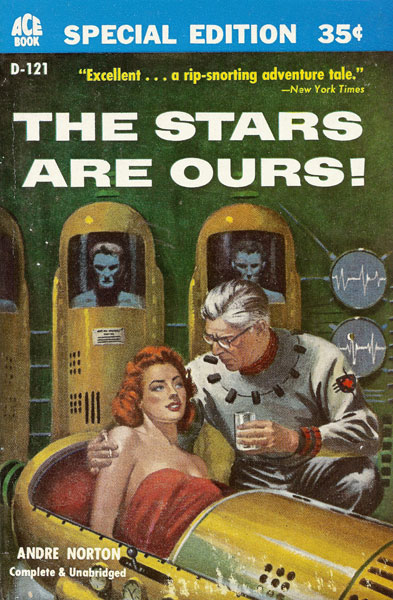
For example, The Stars Are Ours by Andre Norton. When I was young, I focused on the teen hero traveling on a spaceship to colonize a planet in another solar system. I didn’t focus on the reason why they left Earth. On rereading, I see they fled because the U.S. had been taken over by a totalitarian society that was repressing science.
On rereading my beloved Heinlein juveniles, I see Heinlein often portrayed Earth as being overpopulated, over-regulated, or having some kind of society that inspired the characters to leave.
When I was twelve and thirteen, I went to three different seventh grade schools, and two different eighth grade schools. Those were the years when I realized my parents were alcoholics. Those were the years they began to fight. And those were the years when my dad had his first heart attack. Is it any wonder that I identified with characters who left a bad world hoping to find a better one?
I loved stories like Ray Bradbury’s “The Million-Year Picnic.” I always remember the ending, where the father shows the three boys the Martians, and I always forget that the father had taken his family to Mars because Earth had destroyed itself in a nuclear war. But rereading Bradbury’s classic short story reveals that its power is a love of family and an appreciation basic human goodness.
Was science fiction back then really about escaping 1950s reality? And today, do I crave reading 1950s to escape from 2025? Is science fiction just another fantasy portal to leave here and now?
Science fiction grew up in the 1960s and 1970s. Stand on Zanzibar by John Brunner and Camp Concentration by Thomas Disch, both from 1968, were explicitly about how reality sucked. Reading them made me feel grown up. By then, even though I was still in high school, I was nostalgic for 1950s science fiction. But it wasn’t the 1950s themselves that I craved. It was the escapist fantasies of that decade.
I need to think deeper about that.
Could I be in a time loop?
JWH
 Auxiliary Memory
I feel the same way, for somewhat different reasons. (I never had a strong interest in space travel in real life.) I often go back to Clark, Asimov and Bradbury, even while also enjoying other forms of SFF (Borges, Calvino, etc.)
Thanks for the post. I really relate. I’m slightly older than you (I was 12 in 1962).
I think one of the factors that made that old science fiction so powerful to me was scarcity. My primary source for science fiction was the public library in Glenview Illinois. I read “Star Born”, the sequel, years before “The Stars are Ours”. The library had “Second Foundation”, but neither of the predecessors.
So each new science fiction discovery was a precious thing, even if the actual text was not that great. And I was required to invest a lot of my own imagination to fill in the gaps , which added value. I think Jo Walton expresses some of this feeling in “Among Others” https://en.wikipedia.org/wiki/Among_Others
t
When I first discovered science fiction I didn’t know the term existed. I’d roam up and down the school library’s bookshelves looking for books about going into space. This was after discovering Danny Dunn and Tom Swift, Jr. books in the 5th grade. One of my first discoveries was an omnibus of WHEN WORLDS COLLIDE and AFTER WORLDS COLLIDE. That book had so many first sense-of-wonders in it.
I loved AMONG OTHERS. Jo Walton caught the spirit of becoming a science fiction fan perfectly.
In my small town’s library I was exposed to my first written science fiction in 1976 when I was 10 years old. The library had a two volume hardcover set called A Treasury of Great Science Fiction edited by Anthony Boucher which had been published in 1959. When I checked those books out the card which showed previous readers hadn’t been touched since the late 60s so obviously I stumbled on a real diamond-in-the-rough.
The treasury contained 4 novels: The Chrysalids by John Wyndham, The Weapon Shops of Isher by A.E. Van Vogt, Brain Wave by Poul Anderson and The Stars my Destination by Alfred Bester. In addition there were short stories by Ray Bradbury, Robert A. Heinlein, Philip K. Dick, Henry Kuttner and C.L. Moore, Theodore Sturgeon, Arthur C. Clarke and even E.B. White, amongst others. I really never looked back after that.
Afterwards when I was looking to branch out I ended up reading a lot of Alan Dean Foster. In retrospect he’s not that great of an author but it seemed (to my young eyes) that his name was every where. His media tie-in novels were also the way I got to read the stories of the R-Rated movies I wasn’t allowed to see like Outland and Alien.
I know you aren’t necessarily looking for recommendations but Suzanne Palmer’s Fergus Ferguson series starting with book Finder was a real kick-in-the-pants. Also I was surprised how much I enjoyed last year’s Hugo winner Some Desperate Glory by Emily Tesh. It’s not a Juvenile but it has Juvenile tendencies.
I love that two volume Treasury of Great Science Fiction. I recently donated my copy to the library because I have all the novels and most of the stories in other books. I love Brain Wave, The Chrysalids, and The Stars My Destination. Never really liked The Weapon Shops of Isher, but I’ve read that it was very well liked by many.
i’m considering that i should make time this spring and summer to reread some of what i read in my late teens and early twenties( fiction by theodore sturgeon, john wyndham, norman spinrad,and more specifically BRING THE JUBILEE by ward moore, which i got deeply into during a thirty-six hour bus ride from chicago to miami in the late summer of 1970.) i remember a couple raps with you about science fiction during our senior year at killian, mainly frederick pohl and james blish; i still haven’t read much of eithers work. how embarassing!
I started BRING THE JUBILEE the other night, but haven’t gotten back to it.
In the summer of 1970 I made a bus ride from Miami to Memphis. I was heading to California, but stayed with some people in Memphis I liked, and decided to stay.
You might enjoy The Eden Chronicles by S.M. Anderson. 6 books available on Amazon Kindle. The politics of America are eerily similar to what’s happening now. Escaping to a pristine Earth 2.0 sounds amazing. Hard to put down.
I got the free sample. I wish it wasn’t six books. But it does sound interesting. Thanks.