
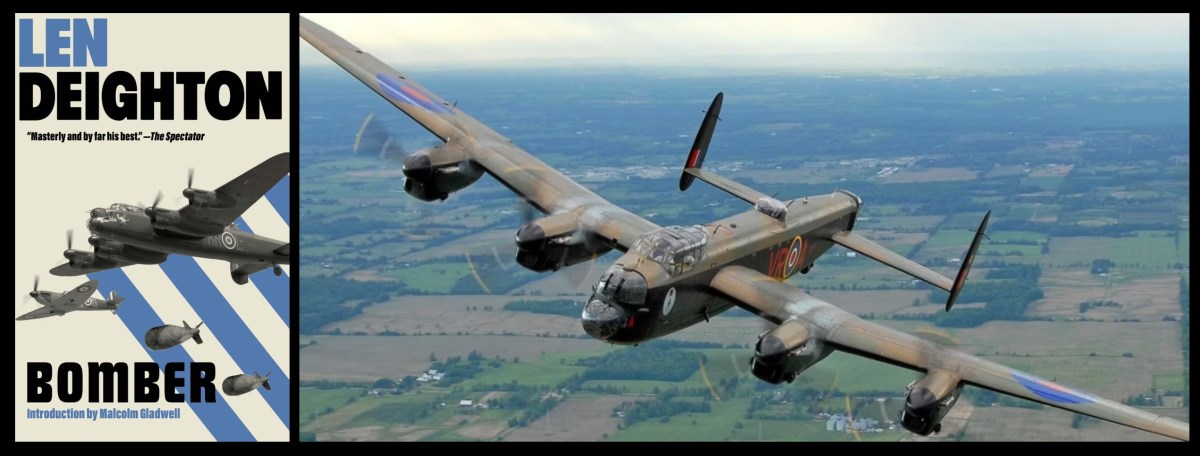
by James Wallace Harris, 9/5/23
I thought Bomber, a 1970 novel by Len Deighton to be an exceptional work about WWII. But saying so will not convince you to read it. How can I describe it best to help you decide? First, if you love books and movies about bomber missions during WWII then you don’t need to read this essay but just go buy the book (if you haven’t already read it). If you love Catch-22 by Joseph Heller and Slaughterhouse Five by Kurt Vonnegut, then you’ll probably want to read Bomber. If you love well-researched historical novels particularly about WWII, or well-written novels in general, then you should keep reading this essay.
Grove Press released a new edition of Bomber on 8/22/23 with an introduction by Malcolm Gladwell. Bomber has been reprinted many times over the last 53 years which says a lot about a book. I listened to the 21 hours and 25 minutes audiobook edition narrated pitch-perfectly by Richard Burnip which includes an afterward narrated by Len Deighton. I loved how Burnip did accents for different characters.
Bomber is about one fictional day, June 31, 1943, that that is so realistic that you keep thinking it’s based on true events. It’s not, but it’s so well-researched and detailed that it could compete with history. Deighton creates over a hundred characters including several Avro Lancaster bomber crews, their German interceptors and controllers, the ground crews and command in England, and the citizens of an imaginary German town that gets bombed to hell by a flying armada of over seven-hundred planes.
Two of my favorite movies growing up were Twelve O’Clock High (1949) and The War Lover (1962), along with the Quinn Martin TV show 12 O’Clock High (1964-1967). And I’ve read nonfiction books and novels about the Blitz and B-17 campaigns over Germany. Bomber gave me a much better sense of what it was like to be in a bombing raid, both in the air and on the ground. Of course, no fiction or nonfiction book could convey the actual experience and horror but this one gave me far more details to consider. It was multiplex and multidimensional.

But Bomber reminds me most of all of Catch-22 (1961) and Slaughterhouse Five (1969), two classic anti-war novels from the 1960s. Those two novels had comic aspects, and Bomber does not. However, all three novels depict the horror of war on innocent individuals. Wars are born out of the egomania of a few, who inflame the passions of true believers who then force millions of helpless bystanders into their deadly squabbles. These books are about ordinary people who want to live ordinary lives but are forced to play parts in the conflicts created by these evil egos.
In the afterward of the new edition Len Deighton talks about how he produced the idea for Bomber. He was studying WWII and thought one way of looking at the war was to visualize it as our machines against their machines. He said he liked machines, but to tell the story he had to talk about the people behind the machines. He didn’t want it to be science fiction. (By the way, he talked about using an IBM MT word processing machine, one of the earliest dedicated word processors, and said he thought Bomber might be the first novel to be written with word processing. I worked three years on an IBM MT/ST machine.)
In Malcolm Gladwell’s introduction to the book, he suggests that Bomber is about the evil and guilt the British felt specifically targeting German citizens during their nighttime bombing raids. Here’s what Gladwell said in a version of the intro at The Washington Post:
“We British are not an imaginative people,” the activist Vera Brittain wrote, in the opening sentence of her 1944 book “Seed of Chaos.” “Throughout our history wrongs have been committed, or evils gone too long unremedied, simply because we did not perceive the real meaning of the suffering which we had caused or failed to mitigate.”

Brittain was referring to the decision during the Second World War by Arthur Harris, head of the Royal Air Force’s Bomber Command, to send hundreds of planes, night after night, to bomb the residential neighborhoods of German cities. Harris was resolutely unsentimental about his decision. He once wrote that it “should be unambiguously stated” that the RAF’s goal was “the destruction of German cities, the killing of German workers, and the disruption of civilized life throughout Germany … the destruction of houses, public utilities, transport and lives, the creation of a refugee problem on an unprecedented scale.” His nickname was “Butcher” Harris, a sobriquet employed with a certain grudging respect, on the understanding that butchers can be useful in times of war. Harris was a psychopath. Twenty-five thousand people in Cologne once burned to death, in one night, on his orders. And Vera Brittain’s point was that the people of England acquiesced to his decision because they did not have the imagination to appreciate what those deadly bombing campaigns meant to those on the ground.
I didn’t get that reading Bomber. It’s there if you read between the lines, but Deighton doesn’t preach or philosophize in the novel. Bomber is a perfect example of show don’t tell writing. Nor does Deighton make his characters into heroes or anti-heroes.
Even though Bomber is told through a couple dozen main characters, with several dozen walk-on parts, the story focuses on Sam Lambert who is a Flight Sargeant and Captain of the Creaking Door, an Avro Lancaster, a 4-engine British bomber. Lambert is the Yossarian or Billy Pilgrim of this story. Lambert isn’t always on center stage though because Deighton considered it especially important to tell the story of the people he bombs, the people who try to kill him, as well as the other airmen who fly with Lambert, both in the Creaking Door and other planes.
I was particularly taken by this Solzhenitsyn quote “to do evil a human being must first of all believe that what he’s doing is good” taken from this review (which I recommend reading). Deighton doesn’t preach or sermonize in Bomber, but there is much to meditate on in his story. In recent years I’ve been reading more history books, and history is really one long succession of wars. My take is evil is caused by a few individuals who need to feed their monstrous egos, as well as the people who worship and follow those psychopathic egos.
There is one scene in Bomber that was very minor but very telling where a commanding officer tried to coerce Ruth into getting her husband, Sam Lambert, to play on the company’s cricket team. It showed how that officer’s ego manipulated reality for doing what he thought was good. If you read Bomber, notice how often that happens.
JWH
 Auxiliary Memory
Yep – I bought the Kindle version of Bomber. Just finished The Making of the Atomic Bomb by Richard Rhodes – thought it would be good reading while waiting for Oppenheimer to come to streaming platforms. What a work! Fascinating, scary, and very grim reading. I’m also reading (and highly recommend) Spies: The Epic Intelligence War Between East and West by Calder Walton
Thank you, that’s great. ‘Bomber’ is a masterpiece. The first time I read it I was floored. It actually changed the way I think about WW2. There was a similar book called ‘Fighter’, which is unavoidably dragged into the politics of the RAF. But, to me, ‘Goodbye Mickey Mouse’ had a powerful effect, similar to ‘Bomber’. IMO Len Deighton is an under appreciated writer (at least by me). My favorite thing by him is a collection of his short fiction ‘Declarations of War’.
My only other encounter with Deighton was back in the mid-1960s when I saw THE IPCRESS FILE. Now I want to read more of his books, especially GOODBYE MICKEY MOUSE.
Brittan’s comments are ridiculous. Many of the British didn’t have to imagine what it was like to be bombed as they had experienced it first hand. She obviously didn’t try trotting out that line in Coventry or she would have been put right.
I read Deighton’s Game, Set and Match and Hook, Line and Sinker trilogies decades ago, as well as his SS-GB. Don’t know why I never got around to Bomber and Fighter. Useful nudge.