Clarion West 2002

Eight years ago around this time of year I attended the Clarion West writer’s workshop in Seattle.  Seventeen of us all shared the same ambition to become science fiction writers, but so far I’ve failed to succeed.  A few of my classmates haven’t.  We were told only a handful of us would get ahead with our dreams, and it would take years, and it would not always be as planned.  And that’s come true.

Strangely enough, my Clarion West 2002 group had three guys who were 50 that year, seeking new ambitions for the second half of their lives.  Most of the class were in their twenties, with a couple in their thirties.  At 50, I decided to do something new with my life by going back and pursuing one of my teen ambitions, to write science fiction.  In the eight years since I’ve written damn little fiction, but I’ve written a lot about science fiction on this blog and at Classics of Science Fiction.

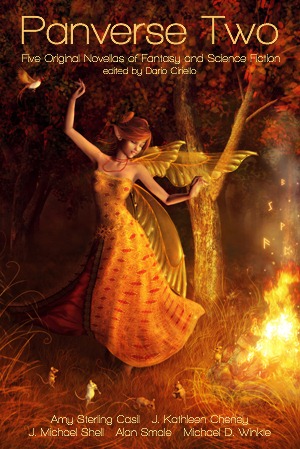
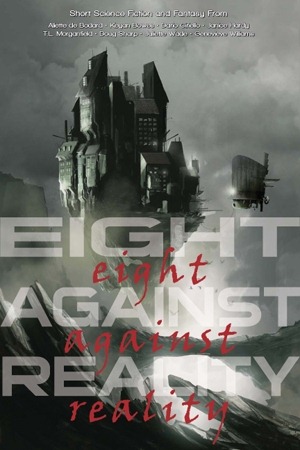
Dario Ciriello has taken a different tack and started Panverse Publishing, and editing anthologies of original stories, with an emphasis on the novella.  With two titles in print and another due in September, Dario has hit the ground running with a promising new career as an editor.  The books have been getting good reviews and they have stunning covers.

PanverseOne

PanverseTwo

 EightAgainstReality

You can get Panverse One and Eight Against Reality now at Amazon, or order direct from the Panverse site.  Panverse One is even available as a Kindle book.  Panverse Two will come out in September.  If you are a patron of writers and small presses, you can get copies of the books and make donations at Wonder. Story.  They’re Back! where Dario talks in a short film about his small press and publishing new writers.

The other Clarion West student that was 50 like me back in 2002 is Doug Sharp.  Doug has spent years living out in the wilderness finishing up his wild science fiction novel and is now looking for an agent.  The epic adventure turned out so long after many revisions that it will be two novels, Channel Zilch and Hel’s Bet!  Doug’s blog Walden 3.0 is fascinating account of a modern Thoreau living in a cabin in the Minnesota woods with his dogs while writing science fiction.  Doug takes beautiful photos of the wilderness and wildlife and should write a book his real life, something I envy.

I on the other hand, have written practically no fiction since 2002.  I found a writing outlet with blogging and my website The Classics of Science Fiction.  But the longing to write fiction never stops gnawing at me, and every summer around this time, I remember fondly my weeks at Clarion West and my ambition to write short stories and novels.  Each year I reevaluate the question:  Can an old dog learn new tricks.

I’ve taken off this week to work on a short story as a mental return to Clarion West.  I agonize over my lack of discipline, but the reality of me not writing fiction is probably not about discipline but talent.  Hard work and talent does pay off.  T. L. Morganfield, one of my younger Clarion West classmates has had great success with publishing a string of short stories based on Aztec mythology.  Recent publications include one in the July issue of Realms of Fantasy and another story in Dario’s anthology Eight Against Reality.  What I admire about Traci is her constant work at achieving her goal.  I wish I could be more like her.

Ysabeau S. Wilce, another younger Clarion West 2002 alum, won the 2008 Andre Norton Award for young adults, for her novel Flora’s Dare.  I haven’t heard much about my other classmates except for notices about a story published here and there, and other kinds of artistic success.  I especially wish the young classmates all the luck in the world.  They have the time to make their dreams come true and I hope they succeed.

I hope by next summer when I think of my time at Clarion West that I will have finished the short story I’m working on now, and maybe a few more.  I want to prove that an old dog can learn new tricks.

JWH – 7/6/10

How Kindle and Nook Can Better Compete With The iPad

Last weekend I wrote “To Ebook or Not To Ebook” and I’m still agonizing over which ebook reader to get.  There are two main issues I’m still worrying over.  First, which book is the most comfortable to read for long periods, and second, which ebook reader is the most universal in terms of buying ebooks.  I imagine the light E-Ink readers, the Nook and Kindle, are easier to hold for long periods of time, but it’s obvious the iPad can read books from Amazon, B&N, iBooks, and many other smaller ebook sellers.  The iPad is almost the universal ebook reader and I’m leaning towards buying it.

My need for reading comfort might put me in a limited market so my buying desires are of less concern to ebook engineers, but I wished they’d consider them.  I have bad eyes, and back problems that make it uncomfortable to sit long in one position, and an arm problem that makes holding a book pain inducing over time.  I’m getting old and wimpy.  I’d love to sit and read for hours like I used to, but it’s a struggle.  That’s why I fear the iPad – many reviewers have complained its difficult to hold for lengthy reading sessions.

And, besides that, I don’t want Apple to just crush the competition, so how could the Kindle, Nook, Kobo and Sony ereaders better compete with the iPad?

Universal Reader

First off, Amazon, Barnes & Noble and Borders should make a cross license deal to display each other’s DRM material.  That way any Kindle, Nook or Kobo owner could buy and read books from all the leading booksellers.  The obvious solution would be a universal ebook format and DRM, but that might take years to hammer out.  It might be easier to add competitor’s software to each others readers.  Obviously, the iPad does it with ease.

The reason why I’m leaning towards the iPad is because I can buy books from all the major ebook retailers and read it on the iPad.  If the E-Ink readers want to compete they need to do the same thing.  It was foolish of Amazon to start the trend for proprietary readers.

Add a Handle with Trigger

The second way to compete with the iPad is make the E-Ink readers even more svelte and easier to hold.  I wished they came with a detachable handle so the ebook reader would look something like a church fan.  A nice handgrip with a trigger to page forward would make holding an ebook reader nicer, and make the page turning more convenient.  You can leave the back page button on the reader because it wouldn’t be needed that often.  I don’t know this for sure, but I imagine a handgrip handle would be more comfortable to hold than holding the ebook reader like a book. 

I’m talking about making the device comfortable for reading 8 hours at a stretch.  This is where the iPad is weak.

The Third Option

I’ve even thought of another option, but this one by-passes the E-Ink technology.  Keep the books in the handle and beam the content to a pair of special glasses via Bluetooth.  I wonder if it’s possible to make a pair of glasses that displays words that are even easier to read, something that helps the reader tune out the world and become one with the word.  In the music world we’ve moved the speakers into the ears, why not move the page right in front of the eyes?

Why Reading is Specialized

iPad fans lord their gadgets over the E-Ink readers claiming its a universal solution.  They ask why anyone would want a specialized device when one device, the iPad, can do so much.  I think the iPad is a revolutionary device, it moves the computer screen off the desk or lap and into the hands where it makes a big functional difference.  But is that the ultimate location?  And is it the right weight and form factor?

Bookworms like to read for hours on end, and the ultimate ebook reader will cater to that need.  I tend to believe the lower weight of the E-Ink technology gives it a chance to compete with the more glamorous and universal device of the iPad if they are optimized for streamline reading of text.

Many bloggers and journalists have written about the approaching doom for the E-Ink reader, but I tend to doubt those predictions.  That doesn’t mean I won’t buy an iPad any day now, but it also doesn’t mean I won’t buy a Kindle 3 when it comes out.  The new Pearl E-Ink technology is appealing.  It just galls me to think about buying ebook reader that can’t read all ebooks.

The Deciding Factor

To be honest, the universal ebook reader of the iPad sways me more than comfort of the smaller E-Ink technology readers, and I’ll probably buy an iPad for now.  That doesn’t mean I wouldn’t buy an E-Ink reader too, especially if they become a universal reader.  I’m greatly disappointed that most books I’m reading right now aren’t available for any ebook reader.  That sucks.  But we’re living in transitional times for books and times will change soon.

JWH 7/4/10